

 Australia


 United States
 United Kingdom
 Philippines


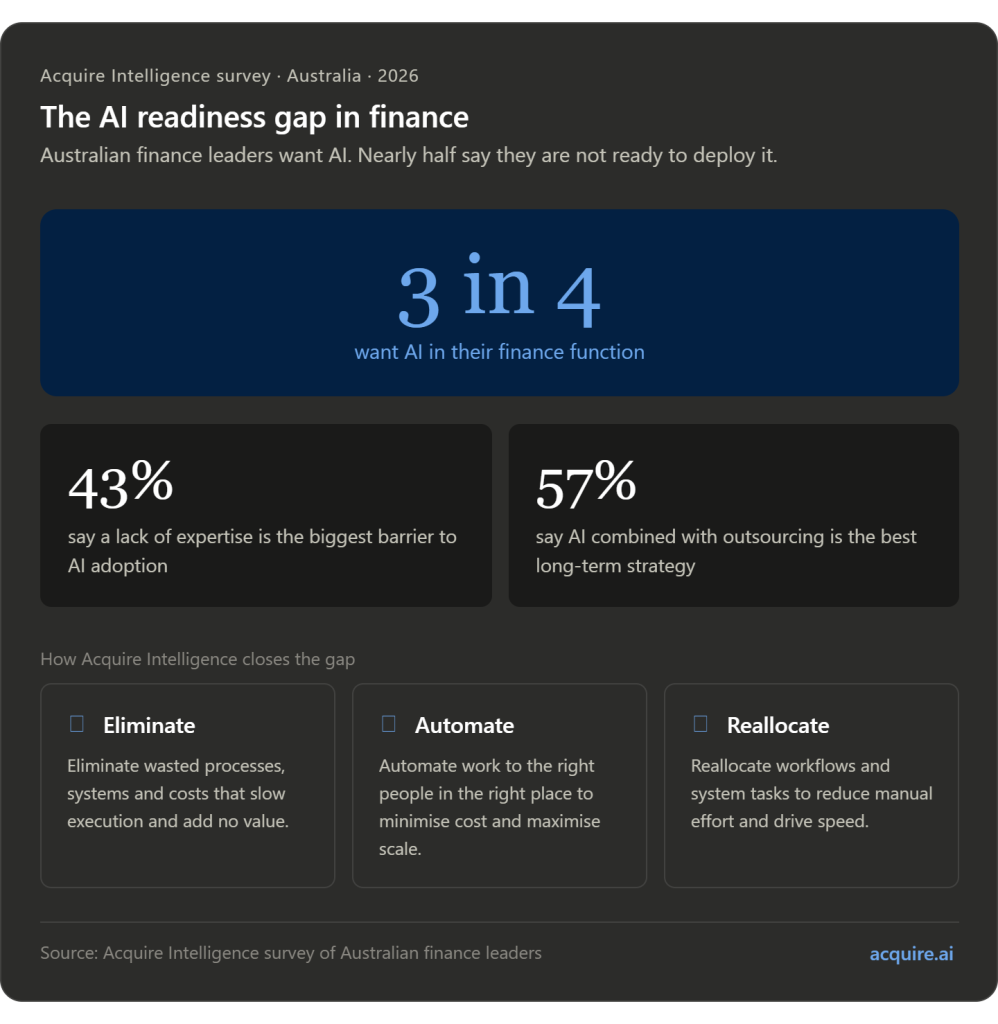
The AI readiness gap is the distance between how much finance leaders want to use AI and how prepared their teams actually are to deploy it. In Australia, that distance is now measurable. Roughly three in four Australian finance leaders want AI in their finance function, yet nearly half say they don’t have what they need to put it to work, according to Acquire Intelligence’s survey of Australian finance leaders.
That gap, not the technology itself, is what separates the finance teams pulling ahead from the ones still stuck in pilots.
What is the AI readiness gap in finance?
The AI readiness gap describes the mismatch between AI ambition and AI capability inside a finance function. Ambition is high: finance leaders can see the use cases in forecasting, reporting, and compliance. Capability lags behind, because deploying AI at scale needs skilled people, clean data, and governance frameworks that most teams have not yet built.
Wanting AI is not the same as being ready for it. Readiness means a finance team can move a use case from experiment to production, explain how the output was generated, and control the risk along the way. Without that foundation, AI stalls at the proof-of-concept stage and never reaches day-to-day operations.
How many Australian finance leaders want AI but say they don’t have it?
Acquire Intelligence’s survey of Australian finance leaders found a clear split between intent and readiness:
- About 3 in 4 want AI in their finance operations.
- 43% say a lack of expertise is the single biggest barrier to AI adoption.
- 57% believe that combining AI with outsourcing is the most effective long-term strategy for finance operations.
The pattern holds well beyond Australia. Independent global finance research across 2025 and 2026 shows only a small share of finance teams describe themselves as very well prepared to manage AI, and only about one in five finance chiefs rate their AI preparedness as advanced. Australian finance leaders sit inside that same global readiness gap, which is why so many are looking outward for the capability they lack internally.
Why does the AI readiness gap exist?
The barrier is rarely the software. Four factors keep Australian finance teams on the wrong side of the readiness gap.
A shortage of in-house expertise. AI specialists who also understand finance are scarce and expensive to hire. This is the barrier Australian finance leaders name most often.
Data quality and integration. AI in finance is only as reliable as the data feeding it. Fragmented systems and inconsistent records limit what any model can do, which is why data quality shows up as both the biggest obstacle and the biggest opportunity in finance AI research.
Governance and assurance. Finance operates in a highly regulated environment where accuracy, compliance, and auditability are non-negotiable. Teams that cannot produce audit evidence for an AI-assisted decision cannot scale that use case with confidence.
The pilot-to-production wall. Many organisations successfully run an AI pilot, then struggle to operationalise it across the finance function. Moving from a controlled experiment to a live process demands redesigned workflows and operating models most teams have never built.
What does the AI readiness gap cost Australian finance teams?
Left unaddressed, the readiness gap shows up on the P&L and in the reporting calendar. Teams that cannot deploy AI keep absorbing manual effort in month-end close, reconciliation, and reporting. Forecast accuracy plateaus. Reporting cycles stay slow. Compliance and governance work stays labour-intensive. Finance professionals spend their time processing rather than advising.
The competitive cost is quieter but larger. While one team is stuck justifying a stalled pilot, another has already moved AI into forecasting and planning and freed its people for higher-value work. The readiness gap is where that lead is won or lost.
How can Australian finance leaders close the AI readiness gap?
The most effective route is not to hire scarce AI specialists one by one, and not to rely on traditional outsourcing alone. It is to combine both. This is why 57% of Australian finance leaders see AI paired with outsourcing as the strongest long-term strategy: it delivers the technology and the expertise together, on a proven operating model, rather than asking an internal team to build all three from scratch.
Acquire Intelligence closes the readiness gap through an Eliminate, Automate, Reallocate approach:
- Eliminate. Eliminate wasted processes, systems and costs that slow execution and add no value..
- Automate. Automate work to the right people in the right place to minimise cost and maximise scale.
- Reallocate. Reallocate workflows and system tasks to reduce manual effort and drive speed.
The result is faster transformation with lower implementation risk. Instead of spending months building AI competency internally, finance teams access operating models already optimised for automation and scale, and the specialist talent to run them.
The future of finance is not AI alone, and it is not outsourcing alone. It is AI and people, working together.
Key statistics: the Australian finance AI readiness gap
- 3 in 4 Australian finance leaders want AI in their finance function.
- 43% cite a lack of expertise as the biggest barrier to AI adoption.
- 57% say combining AI with outsourcing is the most effective long-term strategy.
Frequently asked questions
What is the AI readiness gap?
The AI readiness gap is the difference between how much finance leaders want to adopt AI and how prepared their teams are to deploy and scale it. High ambition paired with low readiness leaves AI stuck in pilots.
Why do Australian finance leaders struggle to adopt AI?
The most common barrier is a lack of in-house expertise, named by 43% of Australian finance leaders. Data quality, governance requirements, and the difficulty of moving from pilot to production also slow adoption.
Is AI enough on its own to transform finance operations?
No. Technology alone does not close the readiness gap. Success depends on the right people, clean data, and governance frameworks to run AI reliably, which is why most Australian finance leaders favour combining AI with outsourcing.
How can a finance team close its AI readiness gap without hiring specialists?
By using an AI-enabled outsourcing model that supplies both the automation and the skilled finance talent to operate it, on an operating model already built for scale. This gives teams capability faster and at lower implementation risk than building it internally.
Sources
- Acquire Intelligence. Survey of Australian finance leaders, 2026. (First-party data.)
- AICPA & CIMA. Future-Ready Finance: Technology, Productivity, and Skills Survey. December 2025. https://www.aicpa-cima.com/news/article/ai-transformation-opens-door-for-finance-professionals-to-build-future-ready